A Short History of Coffee in Japan
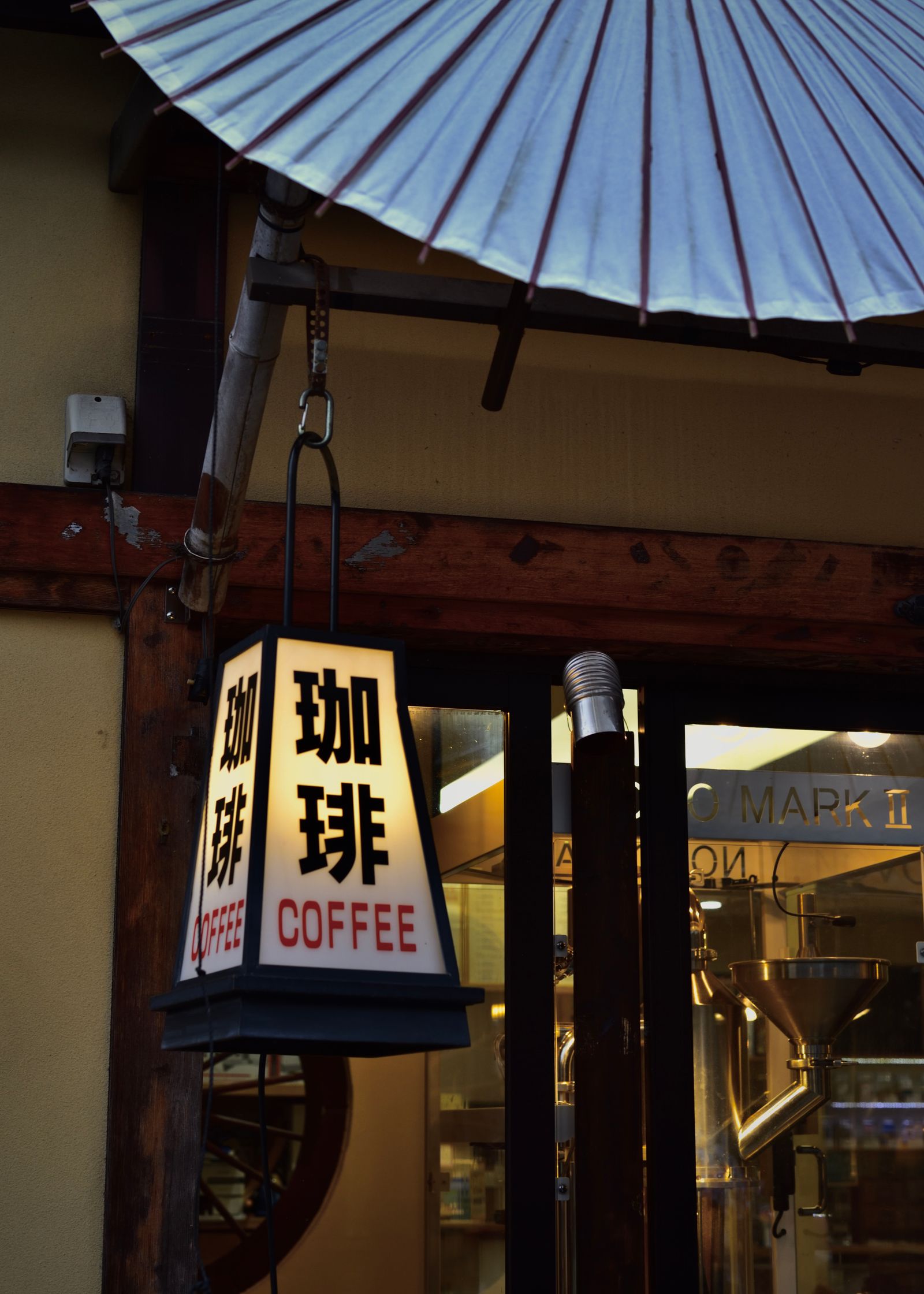
Coffee did not begin in Japan. It arrived on a ship, as a foreign curiosity nobody quite knew what to do with. And yet, four centuries later, some of the tools and ideas that shape how the world brews—the cone-shaped V60 in your kitchen, the slow patience of the pour, the notion that a café can be a room built entirely around a cup—came back out of Japan and traveled everywhere. This is the story of an import that Japan quietly exported back to the world.
What follows is a short history: four hundred years, from the first cup poured at a Dutch trading post to the third-wave coffee bars of today. Along the way we'll pass through Japan's iconic cafés, its jazz listening rooms, its morning sets, and its famous brewing craft—but each of those has a home of its own on this site, so we'll touch them lightly and point you onward. Here, we're following the current.
The First Cup: Coffee Arrives at Dejima (1600s–1800s)
To understand why coffee entered Japan through a single small island in Nagasaki, you have to understand sakoku—the roughly two centuries of national seclusion during which Japan sealed itself off from most of the outside world. For much of the Edo period, foreign trade was funneled through one tightly controlled gateway: Dejima (出島), a fan-shaped artificial island in Nagasaki harbor that served as the Dutch trading post and, for a long stretch, the country's only regular window onto the West.
It was through that window that coffee reportedly arrived, carried by Dutch traders sometime in the 1600s to 1700s. But arriving is not the same as catching on. To most Japanese who encountered it, this bitter black drink was a strange import with no obvious appeal—closer to a medicine or an oddity than a pleasure, and for the most part sampled only by the intellectuals and physicians who circled the Dutch post. For a long time it stayed exactly that: a curiosity.
The early written reactions are wonderfully unimpressed. One of the first records we have comes from the Edo writer and poet Ōta Nanpo, who reportedly tasted coffee aboard a Dutch ship in Nagasaki around 1804 and left a memorably sour verdict—that its scorched, burnt smell made it hard to stand. Whatever the exact wording, the sentiment was clear enough. Coffee had landed, but Japan had not yet fallen for it.
Meiji Modernity: Japan's First Coffee Houses (1888–1911)
What turned coffee from oddity into aspiration was a change in the whole country. The Meiji Restoration of 1868 flung Japan's doors open to the West, and with the rush of new ideas, dress, and technology, coffee arrived wearing a new meaning. It was no longer a bitter curiosity—it was a taste of the modern, Western world that Japan was eager to join.
Into that appetite stepped Japan's first true coffee house. By most accounts, the Kahisakan (可否茶館, roughly "coffee tearoom") opened in Tokyo's Ueno district in 1888, founded by a man generally named as Tei Ei-kei (Zheng Yongqing). It was conceived on a European model—not just a place to drink coffee, but a salon where intellectuals could gather and discuss Western thought. It was, in a sense, ahead of its audience: coffee was still expensive and café-going had not yet taken root, and the venture is generally said to have folded within just a few years.
A more durable landmark came a generation later. Café Paulista (カフェーパウリスタ) opened in the Ginza district, reportedly in 1911, and is often described as one of the oldest surviving coffee houses in Japan. Its origin is one of history's stranger footnotes: the café is generally credited to Mizuno Ryō, a figure connected to Japanese emigration to Brazil, and it is said to have been supplied with beans through an arrangement tied to the Brazilian government—the state of São Paulo reportedly sending coffee gratis in thanks for his role in that emigration story. Cheap, plentiful Brazilian coffee helped push the drink out of the elite salon and toward ordinary people.
Between these two rooms, something new took root: the idea that coffee was not just a drink but a place—somewhere you went, sat, and stayed.
The Showa Golden Age of the Kissaten (1920s–1970s)
If the Meiji era planted the seed, the following decades grew a forest. From the Taishō era into the Shōwa period, the kissaten (喫茶店)—Japan's distinctive traditional coffee house—multiplied across the cities and became a central social space: somewhere to read, to meet, to be alone in public with a good cup.
The kissaten was fertile ground, and it sprouted subcultures. One was the jazz kissa (ジャズ喫茶), a café built around a serious sound system where, in an age when imported records were prohibitively expensive, patrons could sit in near-silence and listen to music they could never afford to own. Another was mōningu (モーニング, "morning service"), the beloved practice of pairing a morning coffee with a set of toast, egg, or other small extras—often at no additional cost. Each of these is a world in itself, so we'll leave the details to their own stories.
War and postwar recovery pressed hard on all of this—coffee became a scarce luxury during the lean years before rebounding as the country recovered—but the kissaten endured and, by many accounts, reached its peak in the postwar decades.
Want the full picture of these rooms? Start with What Is a Kissaten?, then explore the listening culture of the jazz kissa and the ritual of the Japanese "morning service" (mōningu).
Perfecting the Pour: Nel Drip, Siphon, and Japanese Craft
Something else was happening behind those kissaten counters—something that would matter far beyond Japan. The masters running these cafés turned brewing itself into a craft, and that pursuit of the perfect cup became a core part of Japanese coffee's identity.
Two methods came to symbolize it. The first is nel drip (ネルドリップ), a pour-over made through a cloth flannel filter. Brewed slowly and attentively, it yields a cup that regulars describe as unusually rich, rounded, and smooth—the signature of the old-school kissaten. The second is the siphon (サイフォン), a vacuum brewer that looks like something out of a chemistry lab: water climbs into an upper chamber, mingles with the grounds, and draws back down through the heat. Set atop a counter, it turned brewing into quiet theater, a show for the person waiting on their cup.
Underneath the technique was an aesthetic: precision over speed, one considered cup over sheer volume. That philosophy—brew slowly, brew carefully, treat a single serving as something worth your full attention—would later become the seedbed for a global hand-brewing movement. But we won't teach the method here; the how-to lives in its own guide on Japanese pour over coffee.
Coffee for Everyone: Instant and the World's First Canned Coffee
While one side of Japanese coffee was chasing the perfect handmade cup, the other side was busy making coffee something you could grab anywhere, any time—and here Japan's story intersects with two remarkable "firsts."
The first involves instant coffee. At the turn of the twentieth century, a Japanese-born chemist generally named as Satori Kato is credited with developing a soluble, instant coffee process in the United States—filing his patent around 1901, showcasing the product at the Pan-American Exposition in Buffalo that same year, and receiving a U.S. patent in 1903. Whether he was the sole inventor is genuinely debated—others, including David Strang in New Zealand, developed early soluble methods before him—so it's fairer to say a Japanese chemist stood near the origin of instant coffee than to hand him the whole crown.
The second "first" is more clear-cut and more Japanese. In 1969, UCC Ueshima Coffee is widely credited with releasing what is generally described as the world's first canned coffee, "UCC Coffee with Milk"—reportedly inspired when its founder, Tadao Ueshima, had to abandon a bottle of milk coffee to catch a train and wondered why coffee couldn't travel with you. A year later, Expo '70 in Osaka put the can in front of the whole country, and sales took off.
From there, canned coffee met the vending machine, and the two became inseparable. Machines dispensing both hot and cold cans—warm in winter, chilled in summer—became a fixture of Japanese daily life, on train platforms and street corners across the country. Coffee had now stretched to both extremes at once: the artisan's single cup on one end, and a can you could buy in seconds on the other. That coexistence—reverent craft and effortless convenience under one national roof—is a big part of what makes Japanese coffee so distinctive.
Third Wave and the V60 Heard Around the World (2000s–Today)
And now the loop closes. To see how, meet a glassmaker. Hario (ハリオ), founded in 1921, is a heat-resistant glass company whose name is generally said to combine the Japanese words for glass (hari) and king (ō)—"the king of glass." For most of the twentieth century it was a maker of laboratory glassware and coffee tools—hardly a household name abroad.
That changed with a cone. The V60—named for its 60-degree cone angle, with spiral ridges inside and a single large hole at the bottom—was released, by most accounts, in 2004. That date tends to surprise people: the dripper that now feels timeless is barely two decades old.
Its timing was perfect. It landed just as third-wave coffee—the 2000s movement toward single-origin beans, lighter roasts, and precise, transparent brewing—was gathering force. The V60 became the movement's global icon, the dripper you'd find on café counters from Portland to Berlin. And here is the twist that makes the whole story rhyme: by many accounts the V60 caught fire abroad—championed in American specialty shops and vaulted onto the world stage after the 2010 World Brewers Cup in London—before it became a phenomenon back home in Japan, arriving in its own country almost as a re-import on the third-wave tide.
So the cup Japan once imported as a foreign curiosity went back out into the world—not just as a drink, but as objects (the V60, the drip scale) and as a philosophy (that brewing carefully is worth doing). Japan borrowed coffee, refined it for four hundred years, and handed it back changed. If you want to try that refinement yourself, the method is waiting in our guide to brewing pour over the Japanese way. And the story didn't stop with the gear: a new generation of Japanese specialty coffee roasters is carrying that third-wave spirit forward today.
A Cup With Four Centuries in It
Trace the whole arc and it's remarkably tidy. A curiosity off a Dutch ship at Dejima; a symbol of modern life in the Meiji cafés; a social world in the Shōwa kissaten; a craft perfected over the nel drip and the siphon; a convenience canned and vended on every corner; and finally a cone of glass that taught the world to slow down and pour. An import, refined, and quietly exported back.
That's the thing worth remembering the next time you set a filter over your cup and start to pour: there are four centuries in it. Ready to taste that history? Start with Japanese pour over coffee.